➤Summary
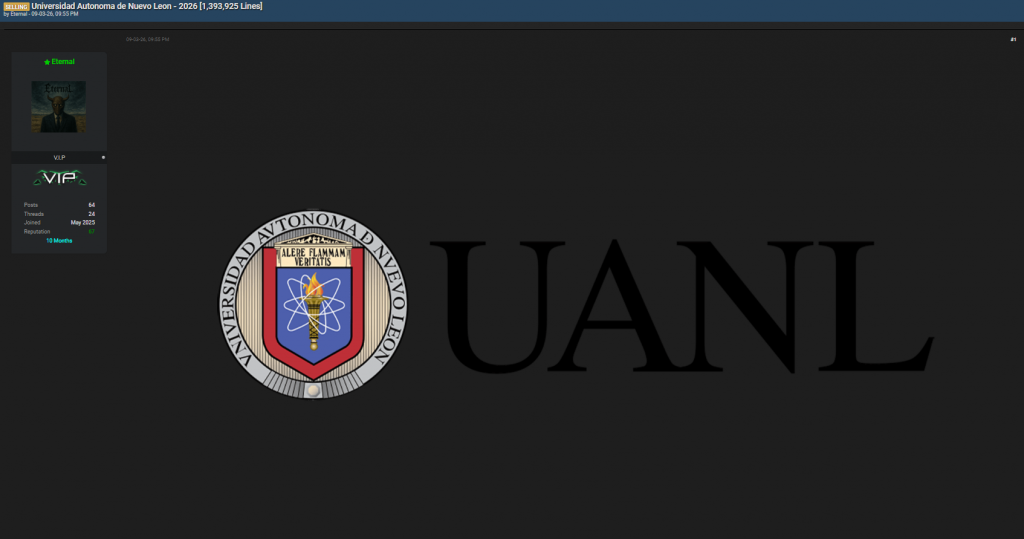
The Universidad Autonoma data leak has emerged as a growing cybersecurity concern after a threat actor claimed to be selling sensitive personal records linked to Universidad Autónoma de Nuevo León (UANL). The listing, posted on Darkforums.su by a user known as “Eternal,” alleges unauthorized access to institutional databases containing student and personal identity information. Reports of the alleged UANL data breach quickly circulated among cyber threat analysts due to the type of data exposed and the attacker’s public statements targeting government entities. 🎯
According to the forum post, the database is currently offered for sale at 255 USD, making it accessible to a wide range of cybercriminal buyers. While independent verification remains ongoing, the structure and scope of the dataset raise serious concerns about data privacy, identity theft risks, and institutional cybersecurity readiness. This spoofguard.io article explores what is known, potential consequences, and what organizations and individuals should understand about this emerging incident.
What the Seller Claims About the Breach
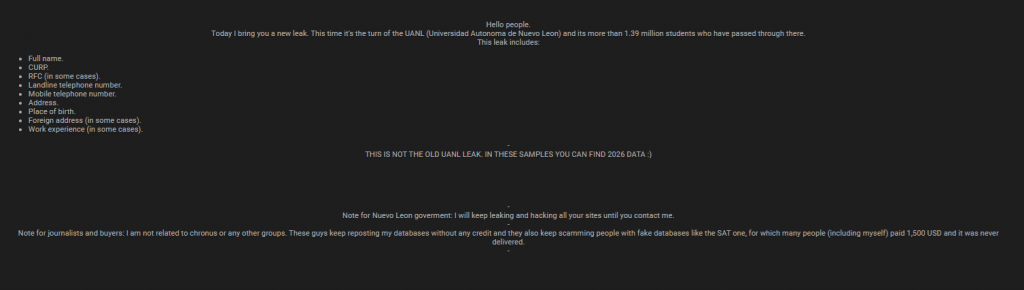
The forum publication includes direct messages from the alleged attacker directed toward government authorities and potential buyers. The author states:
“Note for Nuevo Leon government: I will keep leaking and hacking all your sites until you contact me.”
The seller also claims independence from other cybercrime groups:
“I am not related to chronus or any other groups… they repost my databases without credit and scam people with fake databases.”
Such statements are commonly used in underground marketplaces to build credibility and differentiate sellers from competitors. 🕵️♂️
The listing describes a structured dataset allegedly extracted from university-related systems, suggesting access to administrative or registration databases rather than publicly scraped information.
Allegedly Compromised Information
The claimed dataset includes highly sensitive personal identifiers that could enable identity fraud or targeted cyberattacks.
Reported compromised fields include:
- Full name
- CURP (Mexican Unique Population Registry Code)
- RFC tax identifier (in some cases)
- Landline telephone number
- Mobile telephone number
- Residential address
- Place of birth
- Foreign address (select records)
- Work experience information (select records)
The combination of identity numbers and contact details significantly increases exploitation risks compared to standard academic data leaks. ⚠️
Quick Overview of the Alleged Listing
| Category | Details |
| Institution | Universidad Autónoma de Nuevo León |
| Forum | Darkforums.su |
| Author | Eternal |
| Status | For sale |
| Price | 255 USD |
| Data Type | Personal identity records |
| Verification | Not officially confirmed |
| This format helps cybersecurity professionals quickly assess the credibility and severity indicators associated with the alleged Universidad Autonoma data leak. |
Why Educational Institutions Are Frequent Targets
Universities represent complex digital ecosystems combining academic, administrative, and personal databases. These environments often include legacy systems alongside modern platforms, creating security gaps attackers attempt to exploit. 🎓
Higher education organizations are attractive targets because they store:
- Identity documents
- Financial aid records
- Contact databases
- Employment histories
- Research credentials
The alleged UANL data breach aligns with a global trend in which attackers increasingly target educational infrastructure due to decentralized IT governance and large user populations.
Cybercriminal Marketplace Dynamics
Dark web forums operate similarly to informal marketplaces where reputation determines credibility. Sellers typically price datasets strategically — low enough to attract buyers but high enough to signal exclusivity.
A price of 255 USD suggests rapid monetization rather than long-term exclusive resale. Analysts monitoring underground ecosystems frequently rely on threat intelligence aggregators such as:
- https://spoofguard.io/dark-web-monitoring
- https://spoofguard.io/data-leak-tracker
These internal intelligence resources help track reposted databases and identify recycled breach claims across multiple forums. 🔍
Potential Risks for Students and Staff
If verified, the Universidad Autonoma data leak could expose thousands of individuals to long-term digital risks. Personal identifiers like CURP and RFC numbers are especially sensitive within Mexico’s identity ecosystem.
Possible consequences include:
- Identity theft and fraudulent account creation
- Social engineering attacks
- Financial scams
- Targeted phishing campaigns
- Creation of phishing sites impersonating university services
Attackers often combine leaked data with social media information to create highly convincing fraud scenarios.
Can a University Data Leak Lead to Wider Cybercrime?
Question: Can academic data breaches impact people outside the university?
Answer: Yes. Once identity data circulates online, it can be reused across multiple criminal operations, including banking fraud and telecom scams.
Leaked datasets rarely remain isolated; they are often bundled into larger identity collections traded repeatedly across marketplaces. 📊
Cybersecurity analysts warn that attackers frequently reuse educational datasets to launch credential harvesting campaigns months or even years later.
Verification Challenges in Alleged Breaches
One of the biggest difficulties in assessing incidents like the alleged UANL data breach is distinguishing real leaks from recycled or fabricated datasets.
Researchers typically analyze:
- Data formatting consistency.
- Metadata timestamps.
- Regional identifier accuracy.
- Duplicate record patterns.
- Cross-forum distribution timelines.
A reputable external reference on higher education cybersecurity risks can be found via the National Institute of Standards and Technology cybersecurity guidance, which emphasizes verification and incident transparency as essential response components.
Institutional Impact Beyond Data Exposure
Data breaches do not only affect individuals; they also influence institutional reputation and operational stability. Universities rely heavily on public trust, partnerships, and student confidence. 💻
Key organizational impacts may include:
- Enrollment trust decline
- Legal liability exposure
- Increased compliance audits
- Infrastructure remediation costs
- Media scrutiny and reputational damage
Many institutions now implement brand protection strategies to monitor misuse of institutional identity across digital channels after breach allegations surface.
Practical Security Checklist for Organizations
✅ Incident Monitoring Checklist:
- Monitor dark web mentions of institutional names.
- Track suspicious login attempts.
- Alert users about potential scams.
- Review database access logs.
- Enable spoofing protection for official domains.
- Strengthen authentication policies.
Security teams should also monitor impersonation attempts, as attackers frequently deploy cloned login portals shortly after breaches become public.
The Growing Role of Identity-Based Attacks
Modern cybercrime increasingly focuses on identity rather than infrastructure destruction. Identity datasets allow attackers to bypass traditional defenses by impersonating legitimate users. 🔐
The alleged Universidad Autonoma data leak illustrates how personal records can become long-term attack tools. Instead of immediate exploitation, criminals may store datasets and use them gradually to avoid detection.
Experts recommend combining identity monitoring with proactive awareness campaigns to reduce successful attacks.
Expert Insight
A cybersecurity analyst specializing in academic security environments noted:
“Universities hold data that spans decades of personal history, making them uniquely valuable to cybercriminal ecosystems.”
This observation explains why educational institutions continue appearing in underground marketplace listings worldwide.
What Authorities and Institutions Should Do Next
Even without confirmation, proactive measures are essential. Early response reduces panic and strengthens institutional credibility. 🛡️
Recommended actions include:
- Launch internal forensic investigations
- Notify potentially affected individuals
- Strengthen monitoring of suspicious activity
- Coordinate with law enforcement agencies
- Increase transparency through official communication
Failure to respond promptly often creates greater reputational damage than the breach itself.
Broader Cybersecurity Lessons
The alleged UANL data breach highlights how regional institutions are increasingly targeted within global cybercrime networks. Attackers no longer focus solely on large corporations; educational and public organizations now represent equally profitable targets.
Security leaders emphasize continuous monitoring, employee awareness training, and layered defense strategies as essential safeguards. Institutions must treat personal data repositories as critical infrastructure rather than administrative assets.
Conclusion: Why This Incident Matters
The Universidad Autonoma data leak serves as another reminder that sensitive identity information remains one of the most valuable commodities on underground markets. Whether the dataset proves fully authentic or partially exaggerated, the risks associated with exposed personal records are real and long-lasting.
Universities, governments, and cybersecurity teams must collaborate to improve defensive posture, strengthen identity protections, and ensure rapid incident communication. Individuals should remain alert for suspicious messages, account verification requests, or unexpected contact attempts. 🚨
Cyber threats continue evolving, but awareness and proactive defense significantly reduce impact when incidents occur.
👉 Discover much more in our complete guide
👉 Request a demo NOW
Disclaimer: Spoofguard reports on publicly available threat-intelligence sources. Inclusion of an organization in an article does not imply confirmed compromise. All claims are attributed to external sources unless explicitly verified.