
➤Summary
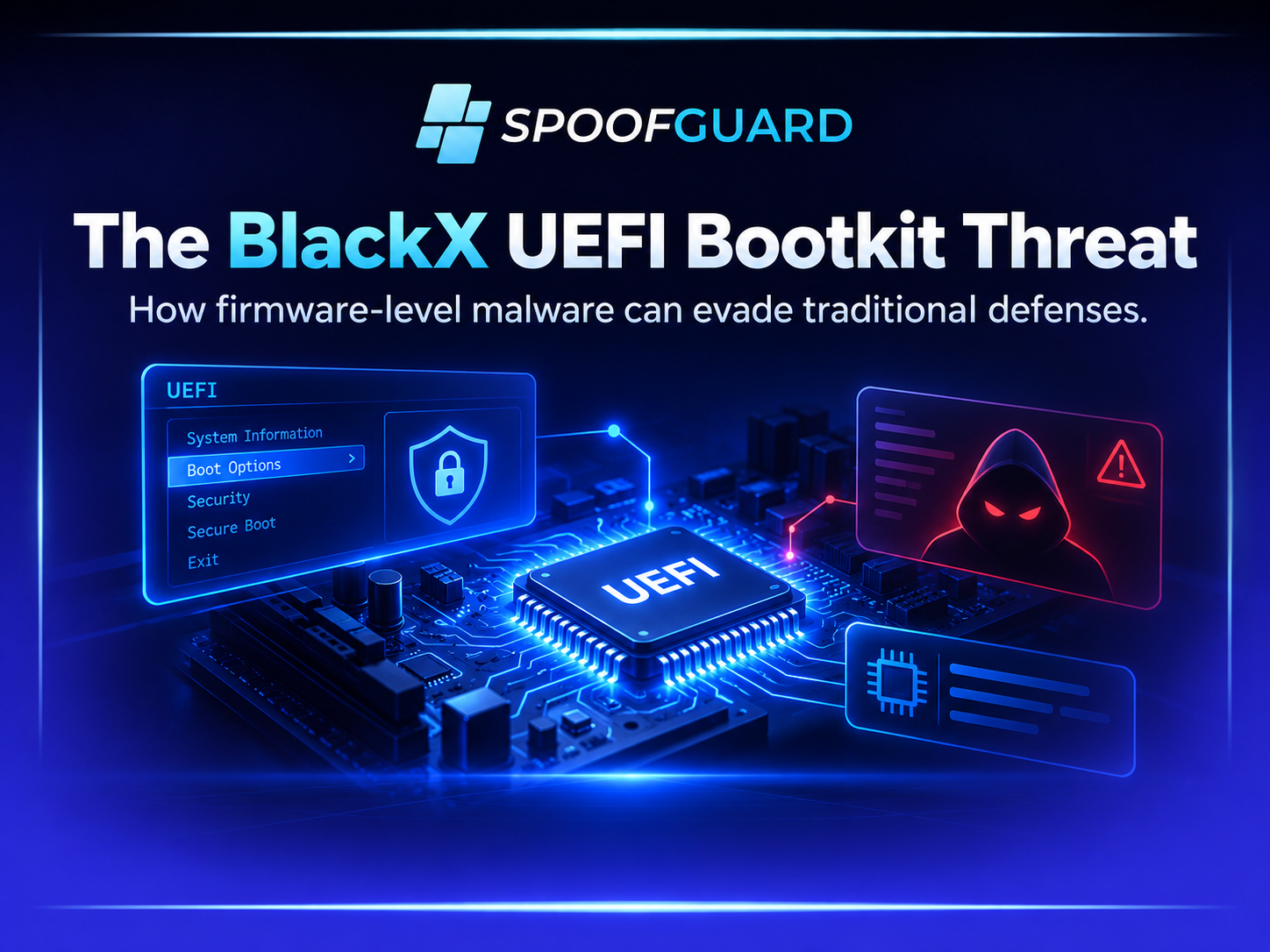
Typosquatting detection helps organizations identify deceptive domains that imitate legitimate brands, but domain monitoring is only one part of a broader cybersecurity strategy. The BlackX UEFI bootkit, reported by BleepingComputer on October 24, 2026, illustrates a different but equally important security challenge: attackers can exploit gaps in existing defenses even when Windows systems have received security updates. The case highlights why organizations need layered protection, careful patch verification, and visibility into threats targeting both internal infrastructure and external digital assets.
Although BlackX is not a typosquatting or domain impersonation attack, its reported use in espionage operations demonstrates why security teams must distinguish between endpoint compromise, malicious infrastructure, and external brand abuse. Each requires different investigation methods, evidence, and remediation measures.
What Happened: BlackX Exploits the Baton Drop Vulnerability
BlackX is a UEFI bootkit identified by Kaspersky researchers during an espionage campaign in early 2026. According to the researchers, the operation targeted diplomatic organizations in Tajikistan, Uzbekistan, and Turkmenistan. Kaspersky attributed the campaign to APT41 with medium confidence, meaning the attribution is an assessment rather than a definitive conclusion.
The bootkit exploits Baton Drop, tracked as CVE-2022-21894, a vulnerability affecting the Windows Secure Boot process. Secure Boot is designed to help ensure that trusted, digitally signed boot components load when a computer starts. By abusing vulnerable components that remain trusted, an attacker can undermine this protection and introduce malicious code before Windows fully loads.
Kaspersky found similarities between BlackX and the previously documented BlackLotus bootkit. Both exploit the Baton Drop vulnerability to bypass startup protections and establish persistence. However, BlackX also uses its own malicious driver and additional espionage payloads.
The case matters because affected systems reportedly had Windows updates installed. The missing protection was not necessarily the operating system update itself, but the additional Secure Boot certificate revocation measures required to prevent vulnerable boot components from loading.
How BlackX Bypasses Secure Boot
UEFI, or Unified Extensible Firmware Interface, initializes a computer and helps load the operating system. A UEFI bootkit targets this early startup process, potentially giving malicious code a position below the normal operating system security layer.
BlackX reportedly uses Baton Drop to load attacker-controlled EFI components and establish persistence through a Machine Owner Key (MOK). It then deploys a malicious Windows kernel driver that interferes with security mechanisms and monitoring.
According to Kaspersky’s analysis, the driver can interfere with security-related processes, modify registry callbacks, and tamper with Event Tracing for Windows (ETW) providers. These activities can make detection and investigation more difficult.
The bootkit also deploys espionage-focused payloads, including a remote access trojan that uses cloud storage services for command-and-control communications and file transfers. Another component, OxiDLLRunner, loads additional malicious code through DLL sideloading.
These capabilities demonstrate why boot-level compromise can be difficult to investigate using ordinary endpoint indicators alone. Security teams may need to examine boot configuration, the EFI System Partition, system events, and other forensic evidence.
Microsoft’s guidance for investigating CVE-2022-21894 and BlackLotus provides relevant background on bootkit persistence, detection artifacts, and remediation.
Why Installing Windows Updates May Not Be Enough
The BlackX investigation highlights a distinction between installing a security update and completing all the associated mitigation steps.
Microsoft’s response to Baton Drop includes revoking trust in vulnerable boot components through Secure Boot’s revocation mechanisms. Kaspersky reported that this revocation did not automatically occur simply because the relevant Windows updates had been installed.
The researchers also warned that the expiration of the Windows Production PCA 2011 certificate on October 19, 2026, did not itself prevent vulnerable components from loading. Expiration and explicit revocation are different security controls.
Organizations should therefore verify the effective security state of their devices rather than relying exclusively on patch-management reports.
Recommended actions include:
- Review Microsoft’s current Secure Boot mitigation guidance and determine which actions apply to each device configuration.
- Verify the status of required Secure Boot certificate updates and revocations, including the relevant DBX state.
- Test mitigation procedures against hardware, firmware, and operating-system compatibility requirements.
- Inspect suspicious changes to the EFI System Partition and boot configuration.
- Correlate endpoint alerts with system logs and other forensic evidence.
- Isolate suspected compromised devices and follow established incident-response procedures.
Changes to Secure Boot should be planned and tested carefully, particularly in environments with specialized boot configurations or recovery requirements.
What BlackX Means for Threat Intelligence Teams
BlackX is primarily an endpoint and firmware-level threat, not a domain impersonation campaign. That distinction matters when organizations determine which security controls and investigative workflows to use.
Endpoint detection and response, firmware security, identity controls, vulnerability management, and incident response remain essential for detecting and containing this type of compromise.
However, the wider attack chain can also involve external infrastructure, suspicious domains, or services used to host and deliver malicious components. Investigators should examine those indicators when supported by the evidence rather than assume that every related domain is malicious.
This is where domain threat intelligence and typosquatting detection can contribute to a broader investigation. Monitoring for domains impersonating an organization, its suppliers, or its technology providers may reveal a separate phishing or fraud risk associated with the incident. It does not, by itself, detect or remediate a UEFI bootkit.
Organizations can explore SpoofGuard’s technology to review its domain-monitoring approach as one layer of external threat visibility.
How Typosquatting Detection Supports Broader Cybersecurity
Typosquatting detection identifies domains that use misspellings or variations of legitimate domain names. Attackers may use these domains to impersonate brands, distribute phishing messages, or direct users to deceptive websites.
Although typosquatting is not the mechanism behind the reported BlackX infection, external domain monitoring can help security teams investigate related risks when an incident involves impersonation or suspicious infrastructure.
A domain investigation should consider several indicators:
- Domain similarity: Does the name imitate a legitimate organization, product, or service?
- Registration information: Is the domain newly registered, and are its registration details relevant to the investigation?
- DNS and certificate activity: Do configuration changes or certificate observations warrant further analysis?
- Website behavior: Does the domain host suspicious content, redirect users unexpectedly, or present a deceptive login page?
- Threat intelligence: Have reputable sources reported malicious behavior associated with the domain?
- Evidence quality: Is the domain confirmed malicious, merely suspicious, inactive, or legitimately operated?
A similar domain is not proof of malicious intent. Analysts should combine multiple indicators and verify observed behavior before assigning a definitive classification.
For teams investigating brand impersonation, SpoofGuard’s article on domain spoofing protection and invisible Unicode phishing provides additional context on how deceptive domain representations can complicate detection.
Brand Abuse Detection and Vendor Risk Management
BlackX also reinforces the need to assess cybersecurity risks across interconnected environments. Vendor Risk Management (VRM) helps organizations understand and monitor the security risks associated with suppliers, service providers, and technology partners.
A bootkit infection does not establish that a third-party provider was responsible. Nevertheless, organizations should evaluate whether their security processes cover the software, firmware, update mechanisms, and external services on which critical systems depend.
Brand abuse detection addresses a different part of the risk landscape. It can help identify suspicious domains impersonating the organization or its partners, while endpoint and infrastructure security controls address compromise within systems.
For enterprises, these activities should be coordinated through established security operations and risk-management processes. For MSSPs, combining internal security monitoring with external domain intelligence can help provide clients with a broader view of potential exposure without confusing suspicious infrastructure with confirmed compromise.
Organizations evaluating brand protection software for companies should prioritize evidence quality, actionable alerts, investigation workflows, and integration with existing security operations. Domain monitoring should complement endpoint protection, identity security, SIEM, MFA, and incident response rather than replace them.
Frequently Asked Questions
What is the BlackX UEFI bootkit?
BlackX is a UEFI bootkit reported by Kaspersky in October 2026. Researchers identified it in an espionage campaign targeting diplomatic organizations in Central Asia earlier that year. It exploits the Baton Drop vulnerability to bypass Secure Boot protections and deploy additional malicious components. Kaspersky attributed the campaign to APT41 with medium confidence.
What is the Baton Drop vulnerability?
Baton Drop is CVE-2022-21894, a vulnerability affecting the Windows Secure Boot process. It can allow attackers with sufficient prior access to exploit vulnerable boot components that remain trusted. Microsoft’s mitigation guidance explains the security implications and the steps organizations should take to investigate and protect affected devices.
Can typosquatting detection identify BlackX infections?
No. Typosquatting detection focuses on suspicious domain-name variations and potential impersonation. It is not a direct method for detecting UEFI bootkits. BlackX investigations require endpoint, firmware, boot configuration, and forensic analysis. Domain intelligence may provide complementary evidence if suspicious external infrastructure is identified.
Why can a patched Windows computer remain vulnerable to Baton Drop?
Installing Windows updates does not necessarily mean every required Secure Boot revocation has been applied. Kaspersky reported that affected systems had received updates but lacked additional revocation measures. Administrators should follow current Microsoft guidance and verify the actual mitigation state of their systems.
Strengthen External Visibility Alongside Endpoint Security
The BlackX case demonstrates why security teams must verify that protections are fully implemented, not simply assume that installed updates have closed every attack path. Organizations should review Secure Boot mitigation status, investigate suspicious boot-level activity, and maintain effective endpoint and incident-response controls.
Where external impersonation risks are relevant, SpoofGuard can complement these measures with domain monitoring and brand protection capabilities. Explore Spoofguard.io approach to domain threat intelligence and assess whether external domain visibility fits your organization’s existing security workflows.
Disclaimer: Spoofguard reports on publicly available threat-intelligence sources. Inclusion of an organization in an article does not imply confirmed compromise. All claims are attributed to external sources unless explicitly verified.