➤Summary
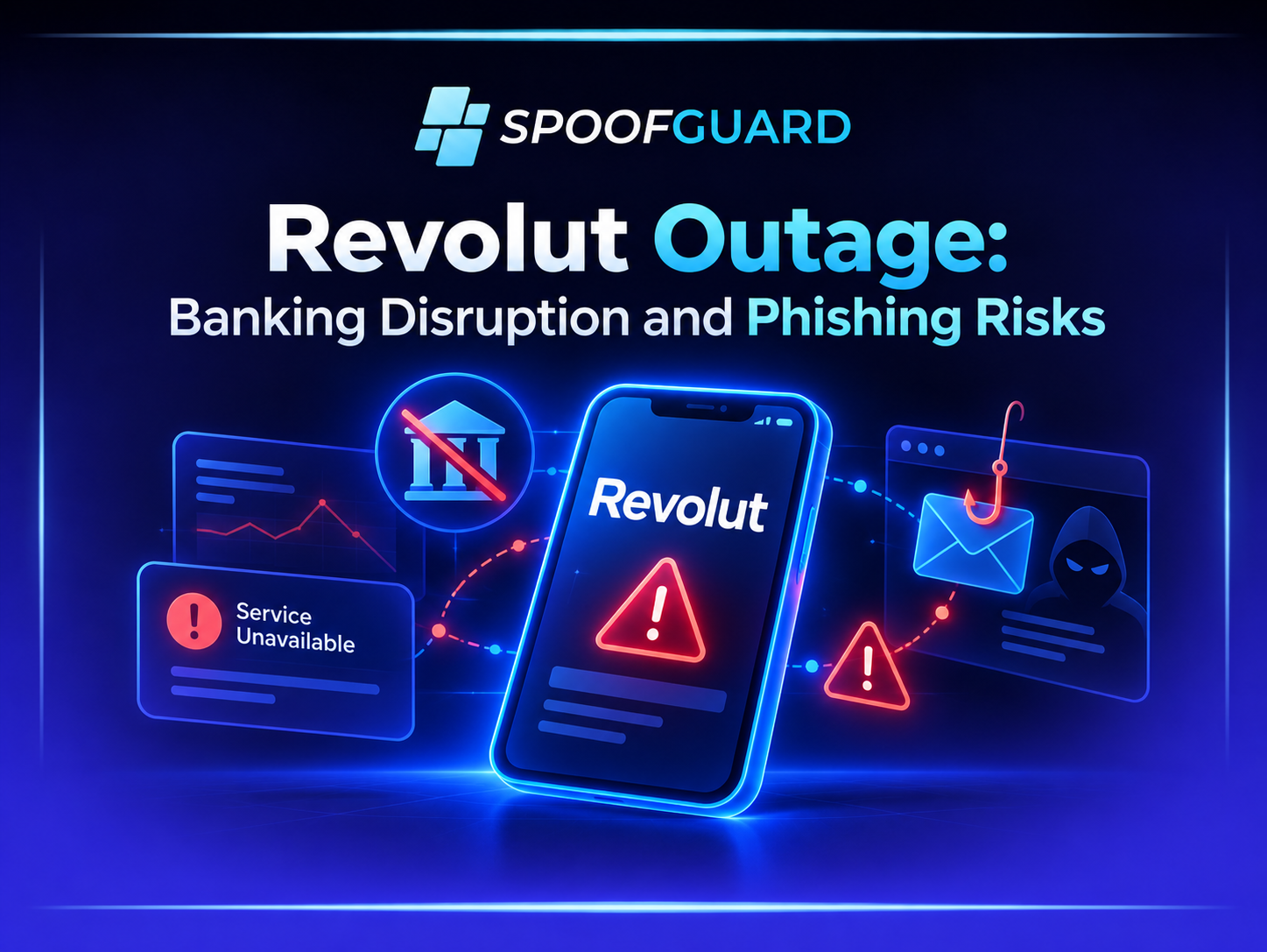
The Revolut outage highlights why domain surveillance matters when financial services experience unexpected disruptions. On October 20, 2026, Revolut experienced a widespread service interruption affecting multiple banking and financial features, including sign-ins, card payments, money transfers, currency exchange, and stock trading. According to BleepingComputer, the company subsequently linked the incident to a Google Cloud outage and confirmed that services had been restored. Revolut also stated that customer funds and data remained safe throughout the disruption.
Although the incident was attributed to a cloud infrastructure failure rather than a confirmed cyberattack, it illustrates a separate security concern: service disruptions can create opportunities for criminals to impersonate trusted financial brands. For cybersecurity, fraud prevention, and brand protection teams, the priority is to distinguish operational failures from malicious activity while preparing to detect scams that exploit customer uncertainty.
What Happened During the Revolut Outage?
On October 20, Revolut reported problems affecting multiple services worldwide. BleepingComputer reported that the company’s status page listed 28 services as partially unavailable, including account sign-ins, card payments, transfers, currency exchange, stock trading, and live customer support.
Customers reported difficulties accessing the application and moving funds between accounts. The disruption demonstrated how a problem affecting underlying technology can interrupt several customer-facing services simultaneously.
According to BleepingComputer’s incident report, Reuters linked the disruption to a power-related event affecting Google Cloud’s London-based europe-west2 region. Revolut later confirmed the connection and announced that its services had been restored.
The company explicitly stated that customers’ money and data remained safe. Public reporting on this outage does not establish that attackers compromised Revolut’s systems or stole customer information during the disruption.
That distinction matters. An availability incident, a data breach, and a phishing campaign are different security events and require different investigative approaches.
Why the Revolut Outage Matters for Cybersecurity Teams
Financial institutions depend on interconnected infrastructure, including cloud computing, identity services, payment processing, telecommunications, and external technology providers. When a critical dependency becomes unavailable, the impact can extend across multiple functions even if the financial institution itself has not suffered a confirmed cyberattack.
The Revolut incident highlights three areas that security and risk leaders should evaluate.
Third-party infrastructure resilience. Organizations need visibility into the services that support critical business functions, along with contingency plans for provider outages. Resilience assessments should consider alternative operational procedures, incident communications, dependency mapping, and recovery testing.
Customer trust and communication. During an outage, customers need accurate updates from official channels. Conflicting information, delayed announcements, or uncertainty about account access can make it harder for customers to distinguish legitimate communications from fraudulent messages.
Opportunistic impersonation. Criminals may exploit public attention around an outage by circulating fake support messages, account verification requests, or fraudulent recovery instructions. This is a plausible threat pattern associated with service disruptions, not evidence that a confirmed Revolut phishing campaign resulted from this particular incident.
Security teams should monitor for observable malicious activity instead of assuming that every disruption has a cybercriminal behind it.
How Service Outages Can Trigger Financial Brand Impersonation
When customers cannot access a banking application, they may search for alternative support channels or respond more quickly to messages promising immediate assistance. Attackers can exploit this behavior through phishing emails, fraudulent advertisements, text messages, social media accounts, or deceptive websites.
A typical hypothetical attack chain may involve three stages.
- Creating urgency. A fraudulent message claims that a payment failed, an account has been restricted, or users must verify their identity to restore access.
- Redirecting the victim. The message sends the recipient to a website designed to resemble a legitimate banking or customer-support portal.
- Attempting to obtain sensitive information. The fake portal requests login credentials, payment information, verification codes, or other sensitive details.
These techniques are forms of social engineering. The attacker relies on the recipient’s trust in a familiar financial brand and desire to resolve an immediate problem.
Understanding how hackers spoof domains helps defenders identify the difference between a legitimate service notification and a suspicious impersonation attempt. Domain spoofing can involve falsified email sender information, while lookalike domains use similar names or characters to mislead visitors. These techniques overlap in some campaigns but are not interchangeable.
A domain that resembles Revolut does not automatically constitute a malicious website. Analysts need additional evidence, such as unauthorized brand use, deceptive login forms, suspicious redirects, or verified credential-harvesting behavior, before classifying a domain as malicious.
Why Domain Surveillance Matters During Financial Service Disruptions
Domain surveillance provides visibility into external domains and related infrastructure that may be used to impersonate an organization. Instead of waiting for customers to report a fraudulent website, security teams can monitor potential threats and investigate suspicious activity as evidence emerges.
For financial brands, useful monitoring signals include:
- Newly registered domains containing brand names or banking-related terms.
- Typosquatting variations that introduce, remove, or substitute characters.
- Homoglyphs and internationalized domain names that resemble legitimate brand names.
- New TLS certificates associated with suspicious brand-related domains.
- DNS, hosting, or registration changes that coincide with the activation of a suspicious website.
- Websites displaying unauthorized logos, login forms, payment requests, or misleading customer-support information.
- Suspicious advertisements or search results directing users to unverified banking portals.
No single signal is conclusive. A newly registered domain may be legitimate, and a similar-looking name does not prove criminal intent. Effective investigations correlate multiple indicators and validate the website’s actual behavior.
Organizations can strengthen this process by combining domain threat intelligence and brand protection with existing email security, identity protection, fraud monitoring, and incident response capabilities.
Domain surveillance also differs from a real-time dark web monitoring solution. Domain monitoring focuses on internet-facing domains, websites, and associated infrastructure. Dark web monitoring focuses on relevant underground sources where stolen credentials, purported data leaks, or illicit offers may appear. Both can contribute to a broader intelligence program, but neither should be treated as a substitute for the other.
How Security Teams Should Detect and Investigate Suspicious Domains
When a financial service experiences an outage, brand protection teams should consider a focused monitoring period around the event. The objective is to identify genuine abuse without generating unnecessary alerts or making unsupported accusations.
- Establish a baseline of legitimate domains
Document official domains, customer-support URLs, approved mobile applications, and recognized communication channels. This baseline gives analysts a reference point when evaluating suspicious websites and messages.
- Monitor newly observed domain variations
Use domain spoofing detection software to identify potential typosquatting, character substitutions, misleading subdomains, and brand-related registrations. Prioritize findings using registration timing, domain similarity, infrastructure history, and observed website behavior.
- Validate evidence before escalating
Investigate whether a suspicious website is active, whether it uses unauthorized brand assets, and whether it attempts to collect credentials or financial information. Where appropriate, examine DNS records, certificate history, redirects, and external threat-intelligence reports.
Preserve relevant evidence, including timestamps, URLs, screenshots where safe, and technical observations. A domain similarity alert should initiate an investigation, not automatically trigger a declaration of confirmed phishing.
- Coordinate response and abuse reporting
When malicious activity is verified, notify the appropriate security, fraud, legal, and brand protection teams. Report the evidence to the relevant registrar, hosting provider, advertising platform, or other service provider through its established abuse process.
Takedown requests should be supported by clear evidence. Removal is not guaranteed, so teams should continue monitoring for changes, reactivation, and additional suspicious domains.
- Connect intelligence to incident response
Feed validated indicators into existing security workflows where appropriate. Security operations teams can correlate suspicious domains with email gateway alerts, endpoint telemetry, identity events, and customer reports.
Organizations can also review SpoofGuard’s domain threat intelligence approach when assessing how external domain monitoring may fit into their broader security program.
What Financial Institutions Can Learn From the Incident
The Revolut outage demonstrates why operational resilience and external threat monitoring should be treated as complementary responsibilities.
| Security priority | Recommended action |
| Service resilience | Map critical cloud dependencies and test recovery procedures. |
| Customer communication | Publish accurate updates through verified official channels. |
| Brand protection | Monitor suspicious domains and fraudulent customer-support portals. |
| Fraud prevention | Review reports of suspicious messages and attempted account impersonation. |
| Incident response | Correlate domain intelligence with internal security telemetry. |
| Risk governance | Document incident decisions, third-party dependencies, and remediation actions. |
For managed security service providers (MSSPs), the same approach can support multiple financial-sector clients. Centralized monitoring and consistent investigation procedures help analysts compare alerts, prioritize credible threats, and communicate findings without confusing suspicious activity with confirmed compromise.
The key is to establish repeatable processes before an incident occurs. Monitoring rules, escalation criteria, evidence requirements, and customer communication procedures should already be defined when an unexpected disruption creates pressure on operational teams.
Frequently Asked Questions
Was the Revolut outage caused by a cyberattack?
Public reporting attributed the October 20, 2026, outage to a Google Cloud incident involving its London region. Revolut subsequently confirmed the cloud-related disruption and reported that services had been restored. The available reporting does not establish that this particular outage was caused by a cyberattack.
Were Revolut customer funds and data compromised?
Revolut stated that customer funds and data remained safe throughout the incident. The reported service interruption should not be interpreted as proof of a data breach. Any separate allegations of compromise would require independent verification and reliable evidence.
How can companies detect phishing during a banking outage?
Companies can monitor suspicious domain registrations, lookalike websites, fraudulent advertisements, and unauthorized customer-support portals. Analysts should validate suspicious findings using website content, DNS information, certificate history, and other relevant evidence. Customer reports and internal email or identity telemetry can provide additional context.
Can domain surveillance prevent financial phishing?
Domain surveillance can improve visibility into suspicious domains and potential brand impersonation, allowing teams to investigate and respond more quickly. However, it cannot prevent every phishing attempt, especially attacks using compromised legitimate websites, messaging platforms, or other channels. It works best alongside email security, phishing-resistant authentication, fraud detection, and incident response.
Strengthen Domain Surveillance for Financial Brand Protection
The Revolut outage is a reminder that organizations need to prepare for both service interruptions and the potential misuse of their brand during periods of uncertainty. Security teams looking to improve external visibility can explore SpoofGuard’s domain monitoring and brand protection platform to assess suspicious domains, investigate impersonation indicators, and support evidence-based response workflows. Integrating domain intelligence into a broader security strategy can help organizations identify emerging risks while maintaining clear distinctions between operational incidents, suspicious activity, and confirmed threats.
Disclaimer: Spoofguard reports on publicly available threat-intelligence sources. Inclusion of an organization in an article does not imply confirmed compromise. All claims are attributed to external sources unless explicitly verified.