➤Summary
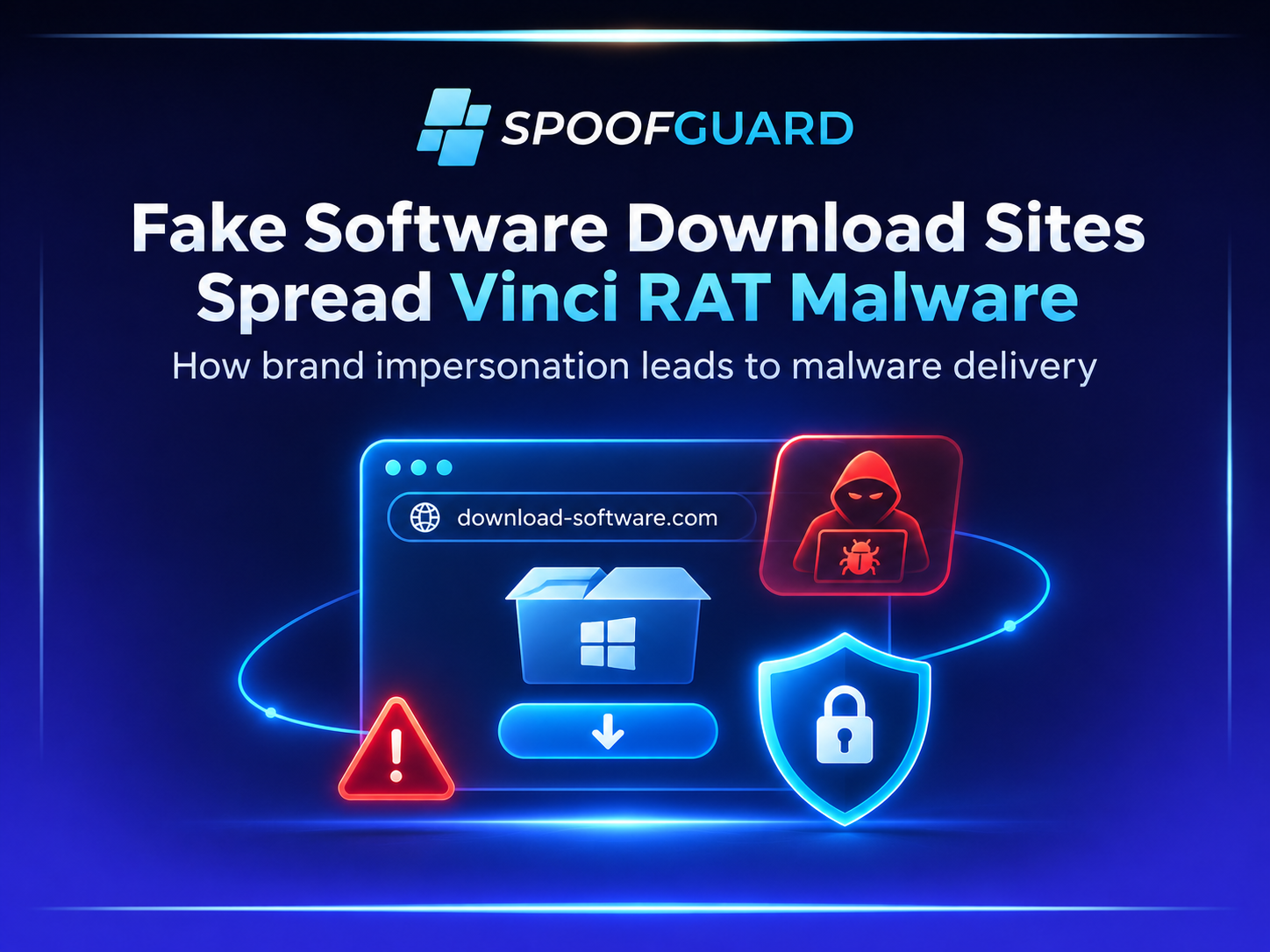
Fake software download sites are becoming a significant threat to organizations as cybercriminals exploit trusted application names and legitimate software distribution channels. Research published by eSentire’s Threat Response Unit on November 24, 2026 revealed a campaign in which a fraudulent software download page directed a victim toward a malicious Microsoft Store application associated with Vinci RAT, a previously undocumented remote access trojan.
Reported by cybersecurity media on November 25, the discovery demonstrates how brand impersonation can develop into a serious endpoint security incident.
For CISOs, security operations teams, and brand protection specialists, the campaign reinforces the importance of investigating suspicious domains before they become established malware distribution channels.
Fake Software Download Sites Behind the Vinci RAT Campaign
The investigation began after a user searching for a Windows screenshot utility encountered a fraudulent download website.
The website offered an installer that ultimately led to the installation of an application called Setup Assistant from the Microsoft Store. Researchers determined that the application contained malicious functionality capable of facilitating unauthorized remote access to Windows computers.
The discovery challenges the assumption that software obtained through a recognized application marketplace is automatically trustworthy.
Security teams should evaluate the complete distribution context, including the originating website, application publisher, requested permissions, and subsequent endpoint behavior.
The research describes a documented intrusion. It does not establish that the legitimate Windows Snipping Tool was compromised or that the Microsoft Store itself suffered a security breach.
What Is Vinci RAT Malware?
Vinci RAT is a remote access trojan identified by eSentire researchers during an investigation involving malicious software distribution. A remote access trojan allows unauthorized parties to interact with compromised computers, potentially execute commands, access information, and introduce additional malicious software without the legitimate user’s knowledge.
The malware presents several potential enterprise security risks:
- Unauthorized access to corporate endpoints.
- Exposure of sensitive business information.
- Installation of additional malicious software.
- Persistent access to compromised systems.
- Potential expansion of an intrusion into other corporate resources.
These represent possible consequences of remote access malware, rather than confirmed outcomes for every affected organization.
How Brand Impersonation Supports Malware Distribution
Fake software download sites succeed because they exploit the reputation of established technology brands.
Employees regularly search for productivity applications, collaboration platforms, browser extensions, and utilities. A convincing imitation of a legitimate download page can make an unfamiliar website appear trustworthy.
In the Vinci RAT investigation, researchers also identified additional subdomains suggesting possible impersonation of Microsoft Teams and Roblox.
These observations demonstrate why brand protection should extend beyond monitoring exact variations of a company’s primary domain name.
Attackers can misuse product names, application icons, software descriptions, and recognizable visual identities without registering a domain that closely resembles the legitimate company’s official address.
SpoofGuard previously examined this broader threat in its analysis of brand protection lessons from fake Zoom malware.
Why Typosquatting Detection Alone Is Not Enough
Typosquatting involves registering domains that resemble legitimate websites through spelling changes, additional characters, or alternative domain extensions.
Although detecting these variations remains valuable, malicious software campaigns do not always depend on recognizable spelling similarities.
An unrelated domain can host a convincing imitation of a software provider, while individual subdomains may reference different products or brands.
Effective domain threat intelligence should therefore consider several complementary signals:
| Risk indicator | Security relevance |
|---|---|
| Domain registration history | Provides context about suspicious infrastructure |
| Brand and logo usage | Helps identify potential impersonation |
| Website content | Reveals misleading software offers |
| Subdomain activity | May expose additional impersonation targets |
| Redirect behavior | Helps establish relationships between websites |
| Hosting and DNS information | Supports infrastructure investigation |
| Malware intelligence | Helps assess potential malicious activity |
No individual indicator proves malicious intent. Analysts should combine technical evidence with contextual information before classifying a website as fraudulent.
Connecting Domain Monitoring With Enterprise Security
Fake software download sites represent an external threat that can eventually produce an internal security incident.
Domain monitoring provides visibility into suspicious web infrastructure, while endpoint detection and response tools help identify malicious activity on corporate devices.
Combining these capabilities allows organizations to investigate threats from multiple perspectives.
Regular security awareness training can help employees recognize suspicious download websites, misleading application listings, and unauthorized software installation requests.
Meanwhile, dark web monitoring can help security teams investigate whether corporate credentials or other sensitive information subsequently become available within monitored underground sources.
There is no established evidence in the cited Vinci RAT investigation that stolen corporate information from this specific incident has appeared on the dark web. Such monitoring should be considered a complementary investigative capability, not proof of data theft.
How Security Teams Can Detect Fake Software Download Sites
Organizations should establish a monitoring strategy that accounts for both their own brands and software providers whose products are critical to business operations.
Monitor suspicious domain registrations
Track domains containing corporate names, product names, common spelling variations, and other relevant brand identifiers.
Prioritize candidates using additional evidence rather than treating every similar registration as malicious.
Analyze website content and infrastructure
Investigate suspicious websites for unauthorized brand usage, misleading download offers, and inconsistencies between the claimed publisher and the actual domain operator.
Certificate transparency records, DNS information, hosting details, and historical website changes can provide useful investigative context.
Correlate findings with security telemetry
Compare suspicious-domain intelligence with corporate DNS logs, secure web gateway events, endpoint alerts, and software installation records.
This correlation helps determine whether employees have interacted with identified infrastructure and whether further investigation is necessary.
SpoofGuard’s domain threat intelligence technology supports external-domain monitoring and investigation as part of this broader defensive approach.
How to Respond to a Confirmed Malicious Download Website
When an investigation establishes that a website is distributing malicious software or impersonating a legitimate brand, organizations should coordinate their response across security, legal, and brand protection teams.
A practical response process includes:
- Preserve relevant screenshots, domain information, timestamps, and supporting evidence.
- Block confirmed malicious infrastructure through appropriate corporate security controls.
- Identify potentially affected employees and devices.
- Investigate unauthorized installations and isolate compromised endpoints where necessary.
- Submit evidence-based abuse reports to relevant hosting providers, registrars, or application marketplaces.
- Continue monitoring for related infrastructure and replacement websites.
Takedown requests should be supported by credible evidence. Removing a malicious website also does not automatically eliminate malware that has already been installed on affected computers.
What MSSPs Should Monitor Across Customer Environments
Managed Security Service Providers face an additional challenge because suspicious software distribution campaigns can affect multiple customers simultaneously.
A domain identified during one investigation may provide useful context for threat hunting across other authorized customer environments.
MSSPs should establish consistent procedures for domain classification, evidence collection, alert prioritization, customer notification, and remediation tracking.
SpoofGuard’s brand protection and phishing detection use cases illustrate how external threat intelligence can support these operational requirements.
Frequently Asked Questions
Can malware be distributed through legitimate application stores?
Yes. Although recognized application stores use security review processes, malicious or deceptive applications may still appear. The Vinci RAT investigation demonstrates why organizations should combine approved software inventories, publisher verification, application controls, and endpoint monitoring rather than relying exclusively on marketplace approval.
Is every lookalike domain a phishing or malware website?
No. Similar domain names may belong to legitimate businesses, unrelated organizations, or authorized partners. Security teams should evaluate website content, infrastructure history, brand usage, and other evidence before determining whether a domain is malicious or submitting an abuse report.
Can domain monitoring prevent Vinci RAT infections?
Domain monitoring can help organizations discover suspicious infrastructure and support earlier investigation or blocking decisions. However, it cannot guarantee the prevention of malware infections or directly inspect compromised endpoints. Effective protection requires complementary endpoint security, application controls, employee education, and incident response.
Does a digitally signed installer guarantee that software is safe?
No. A valid digital signature establishes specific information about the signed file and its publisher, but it does not guarantee that all subsequent application behavior is harmless. Organizations should evaluate software provenance, installation context, application reputation, and runtime activity before establishing trust.
Strengthen Your Brand’s External Threat Visibility
The Vinci RAT campaign demonstrates why fake software download sites must be treated as both a brand protection issue and an enterprise cybersecurity risk.
SpoofGuard helps organizations monitor suspicious domains, identify potential impersonation, investigate phishing infrastructure, and support evidence-based takedown workflows.
Earlier visibility gives security teams more opportunities to assess emerging threats and coordinate appropriate responses.
Start your 7-day SpoofGuard free trial and discover how continuous domain monitoring can strengthen your organization’s defenses against fraudulent websites, software impersonation, and online brand abuse.