➤Summary
Domain threat intelligence has become essential following reports of an alleged massive NG Remita payments data leak shared on the cybercrime forum Dakrforums.su. The post, published on 31 March 2026 by threat actor ByteToBreach, claims unauthorized access to large-scale cloud storage containing sensitive financial and identity data. According to the author, approximately 3TB of Amazon S3 storage was accessed, including hundreds of gigabytes of Know Your Customer (KYC) information and multiple databases. While the claims remain unverified at the time of writing, the scale described highlights growing risks tied to credential exposure, phishing infrastructure, and spoofed domains targeting financial platforms. Organizations must now rely on threat intelligence for domain security and proactive monitoring to reduce downstream cyber risks. 🚨
What Was Allegedly Exposed in the Remita Data Leak
The forum post alleges extensive data extraction tied to NG Remita payment systems. The attacker claims the breach involved cloud storage repositories and backend services.
According to the published statement:
“Around 3TB of S3 storage was accessed… +800GB was only KYC related services… Mysql/Postgres databases, logs, and docker registries.”
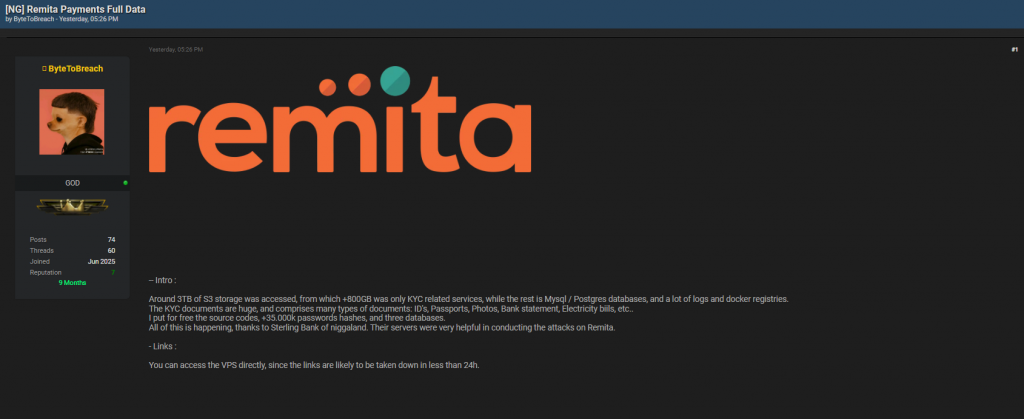
The alleged exposed assets include:
- KYC documents (IDs, passports, photos)
- Bank statements and electricity bills
- Source code repositories released for free
- Over 35,000 password hashes
- Three database dumps
If accurate, this incident represents a major identity exposure scenario rather than a simple database leak. Identity datasets are especially valuable for fraud campaigns and phishing domain detection bypass attempts. 🔐
External cybersecurity reference: https://www.cisa.gov/news-events/news

Why Data Leaks Quickly Become Domain-Based Threats
Modern breaches rarely end with stolen data. Instead, attackers monetize information through impersonation attacks and domain abuse.
This is where domain surveillance becomes critical. Threat actors frequently register lookalike domains after leaks to:
- Launch credential harvesting campaigns
- Create fake payment portals
- Conduct business email compromise (BEC)
- Target customers using spoofed login pages
The alleged Remita exposure could enable attackers to craft highly convincing phishing operations using verified personal information. Effective phishing domain detection helps security teams identify malicious domains before large-scale fraud begins. ⚠️
Understanding the Role of Domain Threat Intelligence in Breach Response
Organizations often focus only on internal remediation, but external threat monitoring is equally important. Domain threat intelligence analyzes how attackers weaponize leaked data across the internet ecosystem.
Key monitoring capabilities include:
| Capability | Security Benefit |
| Domain surveillance | Detects suspicious registrations |
| DNS monitoring | Identifies infrastructure abuse |
| Brand monitoring | Prevents impersonation |
| Certificate tracking | Finds fake HTTPS sites |
| Threat intelligence feeds | Early warning signals |
| These controls help protect company from spoofed domains, a common follow-up tactic after financial-sector breaches. 🌐 | |
| For advanced monitoring solutions, explore: |
Alleged Attack Attribution and Infrastructure Claims
The forum author controversially alleged that the attacks were facilitated through infrastructure linked to Sterling Bank, claiming:
“All of this is happening… their servers were very helpful in conducting the attacks.”
It is important to emphasize that such claims originate from an underground forum post and remain unverified accusations. Cybercriminal forums often include exaggerations or misinformation intended to increase credibility or attract attention.
Nevertheless, infrastructure misuse and cloud misconfigurations remain common root causes in modern incidents. Analysts stress that organizations must investigate logs, access permissions, and exposed storage buckets immediately following such disclosures. 🔍
Practical Checklist: How Organizations Should Respond
Here is a practical response checklist organizations can apply immediately:
✅ Audit exposed credentials and rotate keys
✅ Monitor suspicious domain registrations
✅ Deploy phishing domain detection tools
✅ Enable continuous domain surveillance
✅ Validate third-party integrations
✅ Monitor dark web intelligence sources
✅ Implement threat intelligence for domain security workflows
These steps significantly reduce secondary attack risks tied to leaked identity data.
How Attackers Use KYC Data for Fraud Campaigns
KYC datasets are among the most valuable commodities in underground markets because they enable realistic impersonation attacks.
Common abuse scenarios include:
- Opening fraudulent financial accounts
- Identity theft operations
- SIM swap attacks
- Targeted phishing campaigns
- Synthetic identity creation
Question: Why is KYC data more dangerous than passwords alone?
Answer: Because verified identity documents allow attackers to bypass verification systems, making fraud detection far more difficult. 🧠
Security researchers consistently warn that identity leaks create long-term risks lasting years beyond the original incident.
The Growing Need for Threat Intelligence for Domain Security
Financial platforms are increasingly targeted through domain-based attacks rather than direct system intrusions. Attackers register domains mimicking trusted services immediately after breach news spreads.
Threat intelligence for domain security provides visibility into:
- Newly registered typo domains
- Homograph attacks
- SSL certificate abuse
- Malicious hosting patterns
- Phishing infrastructure clusters
Using continuous monitoring allows organizations to detect malicious activity before customers encounter fraudulent websites.
Platforms like SpoofGuard help organizations protect company from spoofed domains by correlating domain signals with threat intelligence data. 🛡️
Expert Insight: Why Domain Monitoring Is Now Essential
Cybersecurity analysts emphasize that breaches and phishing campaigns are now interconnected phases of the same attack lifecycle.
As one industry expert noted:
“Data exposure is only phase one; domain impersonation is where monetization begins.”
This shift explains why companies increasingly invest in domain threat monitoring alongside endpoint security and SIEM platforms.
The alleged Remita case demonstrates how quickly stolen information may translate into external threats targeting customers and partners.
Conclusion: Lessons From the Alleged Remita Leak
The alleged NG Remita data exposure highlights how modern cyber incidents extend far beyond database compromise. Whether fully confirmed or not, the claims underscore a critical cybersecurity reality: organizations must monitor not only internal systems but also the external threat landscape.
By adopting domain threat intelligence, strengthening phishing domain detection, and implementing continuous domain surveillance, companies can dramatically reduce fraud risks and safeguard user trust.
Proactive monitoring is no longer optional—it is a foundational defense strategy against identity-driven cybercrime. 🚀
Discover much more in our complete guide
Request a demo NOW
Disclaimer: Spoofguard reports on publicly available threat-intelligence sources. Inclusion of an organization in an article does not imply confirmed compromise. All claims are attributed to external sources unless explicitly verified.