➤Summary
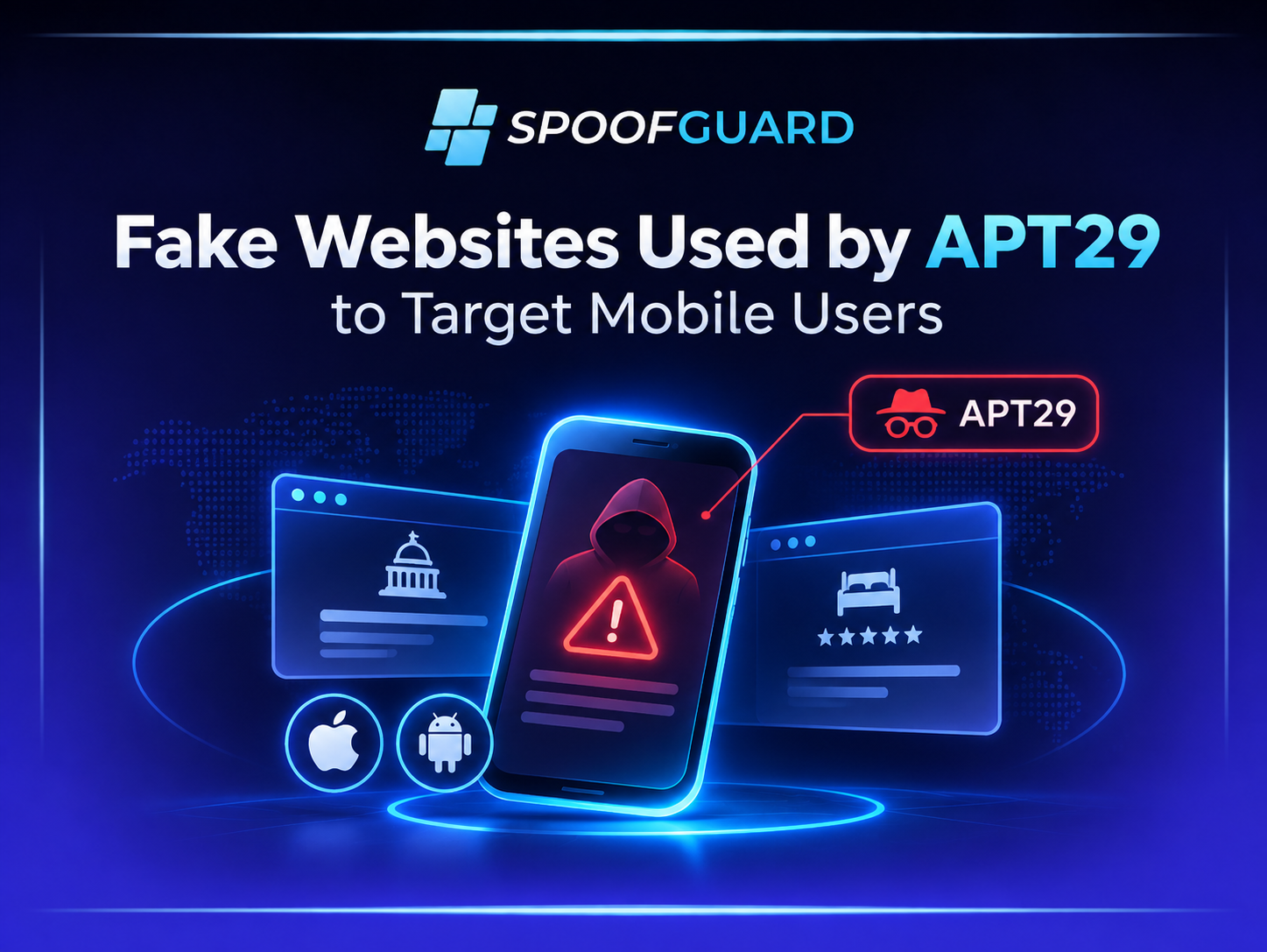
Fake websites impersonating trusted organizations in the United States and United Kingdom have emerged as a key component of a sophisticated mobile cyberespionage campaign linked to Russian threat actors. Security researchers identified malicious websites designed to resemble legitimate online services while silently delivering exploits against vulnerable iOS and Android devices.
The operation, known as Poisoned Source, demonstrates how domain impersonation can evolve beyond conventional credential phishing. Instead of asking visitors to enter passwords or download suspicious applications, attackers used convincing websites and hidden JavaScript to exploit outdated mobile browsers.
For CISOs, SOC analysts, and brand protection teams, the campaign highlights a critical challenge: identifying fraudulent domains before they become part of a broader attack infrastructure.
How APT29 Used Fake Websites to Target Mobile Users
Researchers at Sekoia identified the campaign in October 2026 and published their findings on November 4. They assessed with moderate to high confidence that the activity was associated with APT29, also known as Midnight Blizzard, Cozy Bear, or The Dukes.
APT29 is widely linked to Russia’s Foreign Intelligence Service, although attribution of this specific operation remains an intelligence assessment rather than an independently established fact.
The attackers combined three delivery mechanisms:
- Website impersonation: Fraudulent domains reproduced legitimate websites while injecting malicious JavaScript.
- Compromised legitimate websites: Attackers inserted malicious code into websites operated by genuine organizations.
- Supply-chain compromise: A modified third-party analytics script exposed visitors across multiple websites.
These techniques shared the same objective: identify vulnerable mobile devices and deliver exploits capable of extracting sensitive information.
Unlike traditional phishing, the observed exploitation required no interaction beyond loading a malicious webpage on an affected device.
The Fake US and UK Websites Behind the Campaign
Two attacker-controlled domains illustrate how convincing website impersonation can support advanced cyberespionage.
America250 Website Impersonation
Researchers identified america250[.]holiday, a domain designed to resemble the legitimate America250 initiative commemorating the 250th anniversary of American independence.
The fraudulent website operated as a reverse proxy, displaying content retrieved from the authentic site while modifying the webpage to include malicious JavaScript.
This approach allowed attackers to preserve much of the legitimate visitor experience while introducing hidden malicious functionality.
Sekoia suggested that the commemorative theme could have provided a credible pretext for targeting individuals through invitation-related messages. That proposed targeting scenario has not been independently confirmed.
Raffles London Hotel Website Impersonation
A second domain, theowo[.]club, impersonated the website of Raffles London at The OWO, a luxury hotel near several important British government institutions.
Its proximity to Westminster and the Ministry of Defence made the impersonation potentially significant for intelligence collection.
Researchers considered whether the fraudulent website could have been intended to attract diplomatic delegations or other high-profile visitors.
The domain was reportedly offline when Sekoia published its findings.
Both examples demonstrate why domain spoofing protection and visual impersonation analysis should examine website behavior alongside domain-name similarity.
A convincing copy can present familiar branding while secretly serving attacker-controlled content.
How the Mobile Exploit Chain Worked
The campaign used a technique commonly called a watering hole attack.
A watering hole attack compromises or impersonates websites likely to be visited by a particular audience. Attackers then attempt to exploit vulnerable devices when visitors load those pages.
In this operation, the attack followed four main stages.
1. Website Access
A visitor opened a compromised legitimate website or an attacker-controlled lookalike domain.
The malicious JavaScript loaded as part of the webpage.
2. Device Fingerprinting
A script identified by researchers as UltimateFingerprinter collected information about the visitor’s browser, operating system, and device configuration.
This information helped the delivery infrastructure determine whether the device matched an exploitable profile.
3. Exploit Delivery
The attacker-controlled infrastructure selected an exploit chain compatible with the vulnerable device.
Different exploit chains targeted particular iOS and Android configurations.
4. Data Exfiltration
Depending on the exploit chain, attackers could extract browser cookies, authentication-related information, Wi-Fi passwords, messages, and other device data.
Stolen session cookies are particularly concerning because they may enable unauthorized access to services without requiring the original account password.
The researchers did not establish a public count of successfully compromised devices.
Which iPhone and Android Vulnerabilities Were Exploited?
Sekoia recovered three exploit chains that targeted specific, outdated software configurations.
| Target | Exploit chain | Potential impact |
|---|---|---|
| iOS 16.7 | CVE-2025-43529 and CVE-2024-27834 | Browser cookie theft |
| iOS 18.5 | DarkSword exploit chain | Extensive device data theft |
| Android Chrome 139–145, excluding 143 | CVE-2026-3910 and CVE-2025-27038 | Browser data and Wi-Fi credential theft |
The reported versions represent observed exploit-delivery profiles, not a complete inventory of every potentially affected configuration.
Importantly, all vulnerabilities used in the campaign had already been patched before the attacks occurred.
The operation therefore relied on known, previously fixed vulnerabilities rather than newly discovered zero-days.
Keeping mobile operating systems and browsers updated remains one of the most effective defenses against these particular exploit chains.
Further technical information is available in Sekoia’s original Poisoned Source investigation.
Why Fake Websites Threaten Brand Security
Website impersonation creates risks extending beyond the immediate exploitation of visitors.
Fraudulent domains can imitate an organization’s identity, reuse trusted branding, and make malicious infrastructure appear legitimate.
In this campaign, the fake websites were not simply password-collection pages. They were reverse proxies capable of injecting malicious code into content retrieved from authentic websites.
This distinction matters for defenders.
A website that looks convincing and provides genuine-looking information can still be dangerous.
Organizations should monitor for:
- Newly registered domains resembling their official websites.
- Suspicious variations of brand names and domain extensions.
- Websites reproducing company logos or visual identities.
- Unexpected infrastructure and certificate activity.
- Domains displaying authentic content through suspicious proxies.
- Malicious redirects or injected scripts.
These signals can support an investigation, but domain resemblance alone does not establish malicious intent.
SpoofGuard’s domain threat detection technology combines domain discovery with DNS intelligence, certificate monitoring, website-content analysis, and other external indicators to help investigate suspicious infrastructure.
Such monitoring complements endpoint protection and browser security rather than replacing them.
What the Plerdy Analytics Compromise Reveals
The operation also demonstrated that attackers do not always need to register fraudulent domains.
Between August 27 and September 3, 2026, the attackers modified a JavaScript file belonging to the Ukrainian analytics provider Plerdy SEO Tracker.
Websites loading the affected script could consequently expose their visitors to the attacker’s fingerprinting infrastructure.
This created a supply-chain risk affecting websites that had not necessarily been compromised directly.
For security teams, the distinction is important.
Domain monitoring identifies suspicious external domains, while website integrity monitoring examines whether legitimate websites and their third-party components have been altered.
An effective defensive strategy should consider both.
How Organizations Can Detect and Reduce Website Impersonation Risks
Organizations can strengthen their defenses through a practical combination of domain intelligence, mobile security, and incident-response procedures.
- Monitor lookalike domains. Identify suspicious registrations, brand variations, and websites reproducing official visual identities.
- Analyze suspicious infrastructure. Review DNS records, hosting information, certificates, redirects, and website content before classifying a domain.
- Maintain mobile security updates. Ensure supported iOS and Android devices receive current operating-system, browser, and relevant driver security fixes.
- Investigate suspicious website activity. Correlate known threat indicators with web proxy, DNS, browser, endpoint, and network telemetry.
- Protect authentication sessions. Where compromise is suspected, investigate exposed sessions, revoke affected tokens, and reset credentials when appropriate.
- Review third-party scripts. Maintain an inventory of external website components and monitor unexpected changes to their behavior.
For security teams managing multiple brands or customers, SpoofGuard’s brand protection and phishing detection use cases provide examples of how external-domain investigations can support SOC and digital-risk workflows.
Frequently Asked Questions
What are fake websites in cybersecurity?
Fake websites are attacker-controlled pages created to imitate legitimate organizations, services, or brands. They may be used for credential theft, fraud, malicious redirects, or exploit delivery. Some closely reproduce authentic websites, making visual inspection alone insufficient to determine whether a page is trustworthy.
Can a fake website compromise a phone without user interaction?
Yes, when a device contains vulnerabilities that can be exploited through its browser. In the reported APT29-linked campaign, visiting an affected webpage could trigger an exploit chain without additional clicks. The observed chains targeted outdated software, and the exploited vulnerabilities had already been patched.
What is the difference between domain spoofing and a watering hole attack?
Domain spoofing involves using misleading domain identities to impersonate trusted services or organizations. A watering hole attack compromises or imitates websites likely to attract targeted visitors. The techniques can overlap, as demonstrated by the fraudulent proxy websites identified during this campaign.
Can domain monitoring detect all malicious websites?
No. Domain monitoring can help identify suspicious registrations, lookalike domains, and related infrastructure, but it cannot guarantee detection of every malicious website. Compromised legitimate websites and third-party scripts require additional controls, including website integrity monitoring, endpoint security, browser protection, and incident investigation.
Detect Lookalike Domains Before They Become Security Incidents
The APT29-linked campaign demonstrates how fraudulent websites can become delivery mechanisms for sophisticated attacks against trusted audiences.
Organizations need visibility into suspicious domains, brand impersonation, and emerging external infrastructure before those signals escalate into larger incidents.
SpoofGuard helps security teams investigate lookalike domains, suspicious website content, and potential brand abuse through continuous domain intelligence.
Start a free SpoofGuard trial to explore how proactive domain monitoring can strengthen your organization’s external threat visibility and support faster, evidence-based investigations.