
➤Summary
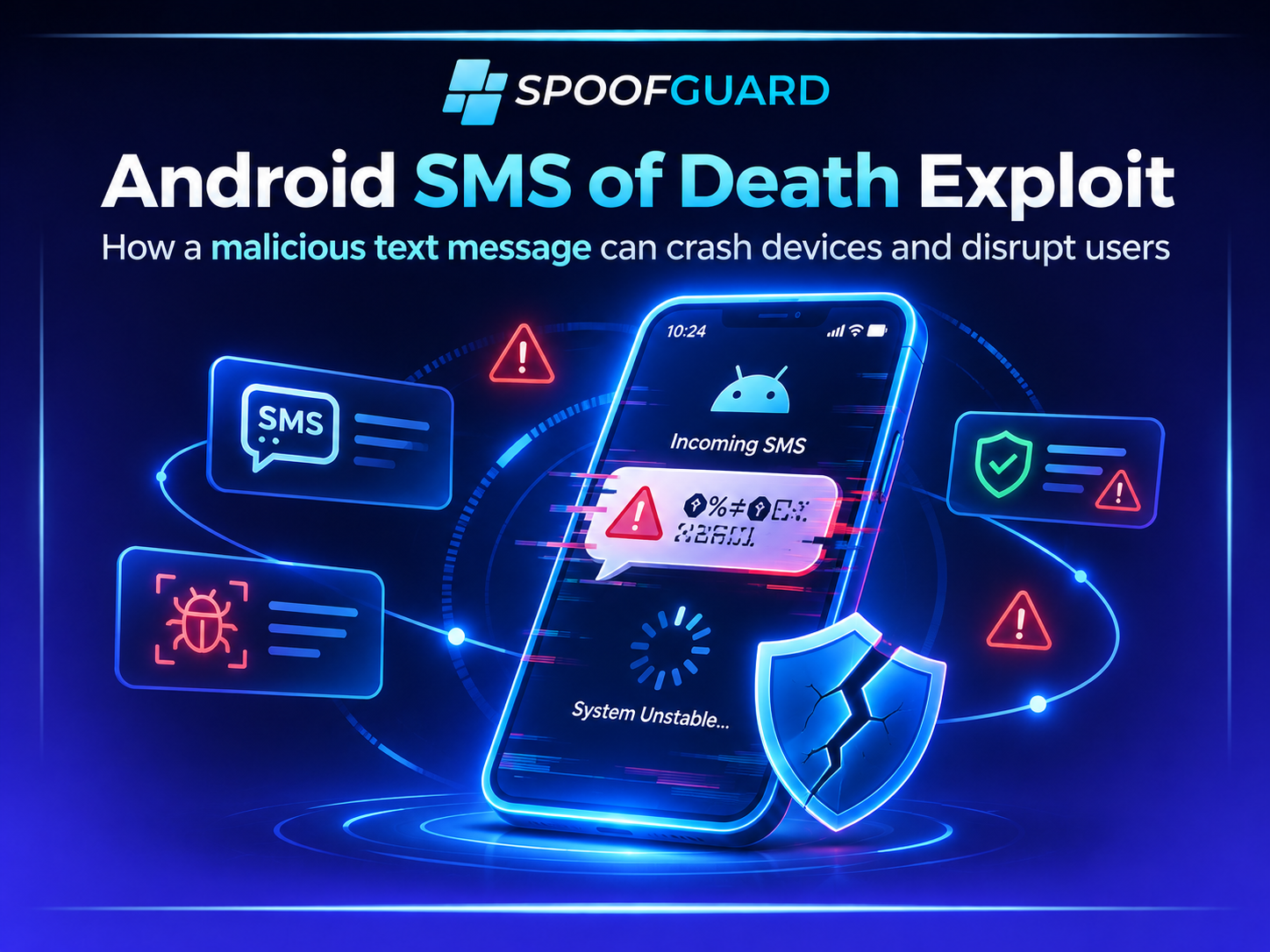
Domain abuse monitoring is primarily designed to identify suspicious domains, phishing infrastructure, and brand impersonation. However, the Android “SMS of Death” vulnerability demonstrates another important aspect of digital risk management: organizations must understand how vulnerabilities in widely used technologies can disrupt employees, customers, and business operations. Tracked as CVE-2026-58882, the zero-click Android denial-of-service vulnerability allows specially crafted WAP Push messages to crash the phone’s cellular service process without requiring user interaction.
What Is the Android SMS of Death Vulnerability?
The SMS of Death is a remotely triggerable denial-of-service vulnerability affecting Android’s telephony framework. According to cybersecurity reporting published by BleepingComputer on October 31, 2026, security researcher Mark Blah released a proof-of-concept demonstrating how a specially crafted text message can crash the Android phone process.
The vulnerability is associated with improper input validation in Android’s WapPushOverSms.decodeWapPdu() function. When the system processes a malformed WAP Push message, an improperly handled header-length value can result in a negative memory allocation and trigger a NegativeArraySizeException.
This causes the com.android.phone process to crash. Because this component manages important cellular functions, the failure can interrupt mobile connectivity and disconnect active calls, including emergency calls.
The particularly concerning aspect is that the message is processed before appearing in the recipient’s SMS inbox. Consequently, users may experience a sudden loss of connectivity without seeing a conventional suspicious message or notification.
How Does the SMS of Death Exploit Work?
The vulnerability involves Android’s handling of specially formatted WAP Push messages.
WAP Push is a messaging mechanism that allows mobile networks and services to deliver certain types of data messages to devices. Android must process these messages correctly to maintain normal telephony functionality.
According to the researcher’s technical disclosure, the vulnerability occurs when Android processes an improperly validated header-length value. The resulting integer can become negative, causing an exception that terminates the phone process.
The reported consequences include:
- Remote disruption: An attacker can trigger the vulnerability without requiring the recipient to open a message.
- Silent execution: The malformed message may be processed before becoming visible in the SMS inbox.
- Interrupted communications: Active calls can disconnect when the telephony process crashes.
- Repeated service interruptions: Carrier redelivery or message reprocessing may trigger additional crashes.
- Device instability: Multiple messages reportedly caused some tested devices to enter reboot loops.
The researcher also published a proof-of-concept application and technical analysis. Since the demonstration can disrupt mobile devices, it should only be used in authorized security research environments.
The original technical disclosure is available at SMS of Death by the vulnerability researcher.
Which Android Versions Are Affected?
The vulnerability researcher reports reproducing the issue on Android versions ranging from Android 12 through Android 16.
According to the disclosure, Google introduced a fix in its October 2026 security updates for Android 14 through Android 17. The correction addresses the exception handling and removes triggering messages to prevent repeated crashes.
However, Android 12 and Android 13 devices reportedly did not receive the same fix.
The following distinction is important when assessing exposure:
| Android version | Reported patch status |
| Android 12 | No reported fix |
| Android 13 | No reported fix |
| Android 14 | October 2026 update |
| Android 15 | October 2026 update |
| Android 16 | October 2026 update |
| Android 17 | October 2026 update |
These version details are based on the researcher’s disclosure and BleepingComputer’s reporting. Actual update availability depends on the device manufacturer, carrier, and supported firmware.
Google’s October 2026 Android Security Bulletin provides information about the month’s security updates. However, CVE-2026-58882 is not listed in that bulletin, so the researcher’s reported fix should not be confused with an independently documented CVE entry in the bulletin.
Organizations should verify the actual security patch level installed on each device rather than assuming that an update has been received.
Why Zero-Click Vulnerabilities Create Business Security Risks
Zero-click vulnerabilities are particularly concerning because they do not depend on conventional user interaction.
Traditional phishing campaigns often require a recipient to open a message, follow a link, download an attachment, or enter credentials into a fraudulent website. A zero-click vulnerability can bypass these behavioral dependencies by targeting how software processes incoming data.
For organizations that rely on mobile devices for business communications, this creates several operational concerns.
Business continuity: Employees who depend on mobile connectivity may temporarily lose access to calls and other cellular services.
Emergency communications: The reported ability to interrupt emergency calls creates a particularly serious safety concern for employees working remotely, in the field, or in critical operational roles.
Device management: Organizations with older Android devices may have difficulty addressing vulnerabilities when manufacturers no longer provide security updates.
Third-party exposure: Companies relying on contractors, suppliers, and external service providers may have limited visibility into the security condition of devices used within their operational environments.
This is where Vendor Risk Management becomes relevant. Organizations should consider mobile security, supported operating systems, patch management, and endpoint protection when evaluating the cybersecurity practices of business partners and service providers.
How Domain Abuse Monitoring Fits Into a Broader Threat Intelligence Strategy
The SMS of Death vulnerability is a mobile software security issue, not a domain impersonation campaign. Domain abuse monitoring cannot directly detect or remediate the underlying Android telephony flaw.
Nevertheless, the incident demonstrates why security teams need visibility across multiple external threat categories.
Attackers frequently exploit public security incidents to create additional opportunities for fraud and impersonation. When a vulnerability receives widespread attention, fraudulent websites and lookalike domains may attempt to capitalize on user concerns by presenting themselves as legitimate update portals, technical support services, or security advisories.
These potential follow-on threats are separate from the Android vulnerability itself and should be investigated independently.
A threat intelligence tool focused on domain security can help organizations identify suspicious infrastructure associated with their brands and investigate possible impersonation activity.
For example, security teams can monitor:
- Newly registered domains resembling official company websites.
- Lookalike domains claiming to provide Android security updates.
- Suspicious websites impersonating legitimate device manufacturers.
- Fake technical support portals targeting employees and customers.
- Fraudulent domains associated with software downloads or security notifications.
- Changes in DNS, hosting, and certificate infrastructure connected to suspicious domains.
Organizations can use SpoofGuard’s domain threat intelligence technology to understand how domain discovery, infrastructure analysis, content inspection, and risk scoring support the identification of potentially malicious websites.
The distinction remains essential: finding a suspicious domain does not automatically establish malicious activity. Analysts should validate website content, infrastructure, and behavior before classifying a domain as malicious.
What Security Teams Should Do to Reduce Exposure
Organizations should address the Android vulnerability through device security and patch management while maintaining visibility into related external threats.
The following actions can help reduce exposure.
- Verify Android security patch levels
Review managed Android devices and identify those running outdated security updates. Prioritize unsupported Android 12 and Android 13 devices for replacement or migration to supported operating systems.
- Apply available security updates
Install the latest available firmware and Android security updates. Confirm that the installation has completed and restart devices when required.
- Maintain mobile device inventories
Use Mobile Device Management or Unified Endpoint Management solutions to track operating system versions, device ownership, security patch levels, and update compliance.
- Investigate unusual device behavior
Unexpected cellular service interruptions, repeated phone-process crashes, and unexplained reboot loops should be investigated. Preserve relevant diagnostic information and coordinate with the device manufacturer or qualified technical support.
- Review third-party security requirements
Include supported mobile operating systems and patch-management practices in supplier security assessments. Organizations should understand whether external service providers maintain devices used to access company information.
- Monitor potential brand impersonation
Following widely reported security incidents, monitor for suspicious domains that misuse company names, device manufacturer branding, or security-update terminology.
A broader brand protection and phishing detection strategy can help security teams investigate suspicious domains and identify potential impersonation attempts.
Frequently Asked Questions
What is CVE-2026-58882?
CVE-2026-58882 is the identifier associated with the Android SMS of Death vulnerability. It is a zero-click denial-of-service issue involving Android’s WAP Push message-processing functionality. A specially crafted message can trigger an exception that crashes the phone process, disrupting cellular connectivity and potentially interrupting active calls.
Can the Android SMS of Death vulnerability steal personal information?
The publicly described vulnerability demonstrates denial of service rather than credential theft or remote code execution. Its reported impact involves crashing the Android telephony process and disrupting communications. The available technical disclosure does not establish that the vulnerability independently enables attackers to access personal files or steal stored information.
Can domain abuse monitoring detect the SMS of Death exploit?
No. Domain abuse monitoring is not designed to identify or remediate vulnerabilities in Android’s telephony framework. However, it can help identify separate threats involving fraudulent domains, fake security-update websites, phishing portals, and brand impersonation that may emerge around widely publicized vulnerabilities.
What should organizations do if they have unpatched Android devices?
Organizations should identify affected devices, verify their available security updates, and prioritize supported firmware. Devices running Android 12 or 13 require particular attention because the researcher reports that these versions did not receive the October fix. Unsupported devices should be evaluated for replacement or isolation from sensitive business operations.
Strengthen Visibility Into External Digital Threats
The Android SMS of Death vulnerability highlights the importance of maintaining visibility across software security, mobile infrastructure, and external digital threats. While domain abuse monitoring cannot replace vulnerability management or mobile endpoint protection, it provides another layer of defense against fraudulent domains and brand impersonation. Explore SpoofGuard to understand how domain threat intelligence can support suspicious-domain investigation, phishing detection, and brand protection as part of a broader cybersecurity strategy.
Disclaimer: Spoofguard reports on publicly available threat-intelligence sources. Inclusion of an organization in an article does not imply confirmed compromise. All claims are attributed to external sources unless explicitly verified.